Why Does My Face Feel Like It Is Sagging?
Most people do not notice sagging skin as a line or a wrinkle. They notice a feeling. The jawline is less defined than it was. The cheeks sit slightly lower by the end of the day. Makeup settles differently. Nothing has obviously changed, and yet the face reads as tired in photographs in a way it did not a few years ago. Patients describe it to us as a sense that the face is dropping, or falling, or simply losing its hold.
That feeling has a physical basis, and it responds to different treatments than lines and texture do. Understanding what is actually happening makes it much easier to tell which treatment is worth your time, because the options that sound similar work in genuinely different ways.
What the dropping feeling actually is
Skin owes its firmness to a supporting network beneath the surface, built largely from collagen and elastin. Collagen gives structure. Elastin gives recoil, the quality that lets skin spring back. From roughly the mid twenties onward the body produces less of both, and the existing network gradually loosens. Sun exposure, smoking, weight changes and genetics all influence how quickly this happens.
The result is laxity, or what most people simply call sagging skin. The skin envelope becomes slightly looser than the structure underneath it, and gravity does the rest. This is why the change registers as movement rather than as a mark on the skin. It is also why treatments aimed at surface quality, however good they are at what they do, tend to disappoint people whose real complaint is descent.
How radiofrequency skin tightening works
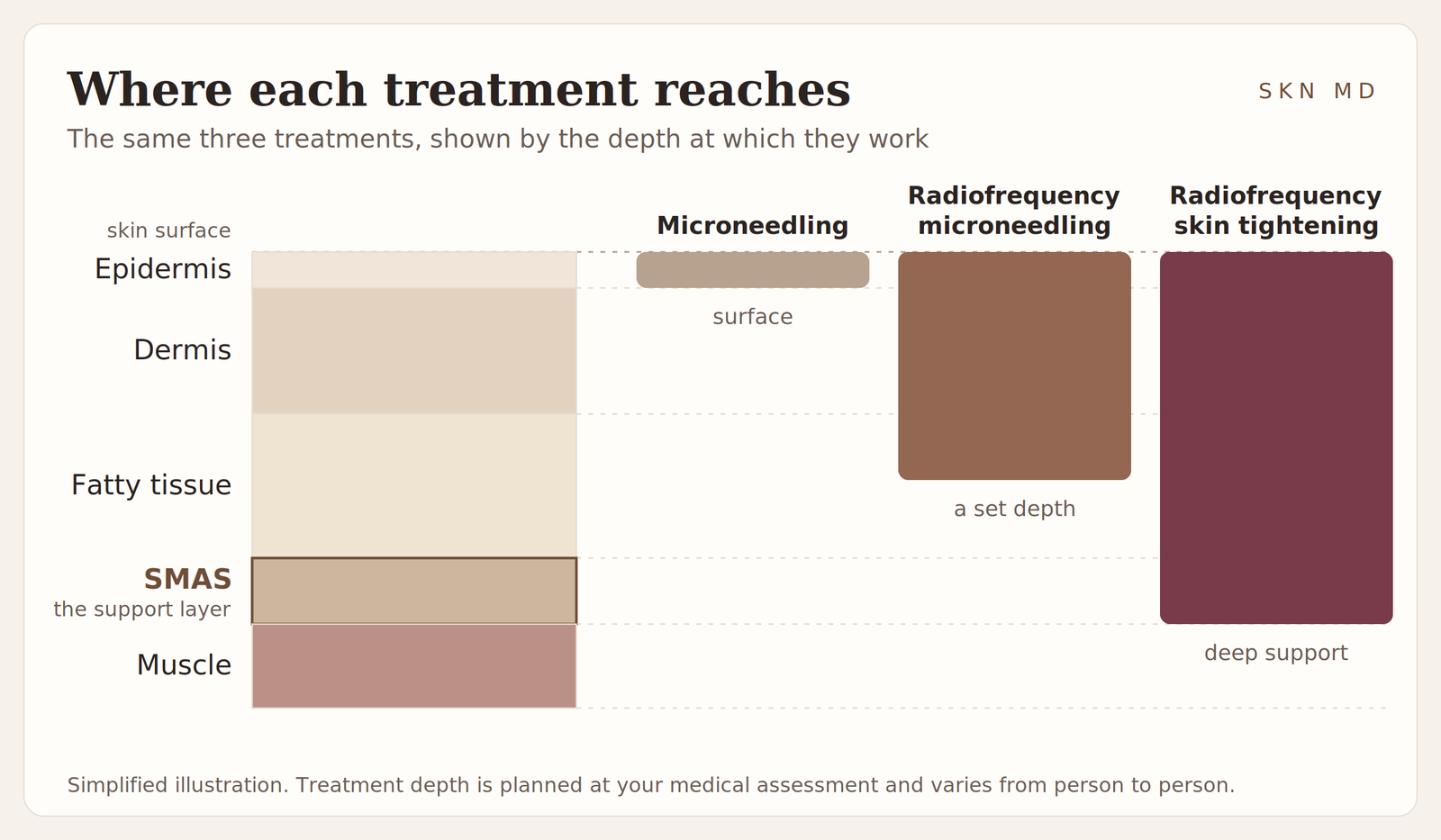
Radiofrequency skin tightening, delivered at SKN MD with the XERF platform, takes a different route. Rather than working on the surface, it passes controlled radiofrequency energy through the skin into the deeper layers, where it produces gentle, measured heat. The manufacturer reports histological analysis indicating that this energy reaches the SMAS, the fibrous sheet of tissue that sits beneath the fat and holds the shape of the face. That warmth tightens the skin’s structural support and prompts the body to produce new collagen over the weeks that follow.
Nothing punctures the skin. There are no needles and no incisions. The treatment is delivered across planned zones, either a single area such as the upper, mid or lower face, the full face, or the full face together with the neck. Most people feel a spreading warmth and little else. A topical numbing cream can be applied for comfort, and most patients tolerate the session well.
Because the mechanism is collagen remodelling rather than injury and repair, the results arrive gradually. A short course of sessions is often recommended, with maintenance over time, and a review is included to look at progress. Individual results vary. You can read the full treatment overview on our radiofrequency skin tightening page.
Why it is not the same as microneedling
Microneedling, also known as collagen induction therapy, uses very fine needles to create controlled micro channels in the skin. The body repairs those channels, and the repair process prompts fresh collagen and elastin. It addresses acne scars, fine lines, enlarged pores, uneven texture, hyperpigmentation and loss of elasticity in the skin itself, over a series of four to six sessions.
The distinction worth understanding is one of depth, and it is the whole point. Microneedling improves the quality and elasticity of the skin you have, working at the surface and in the upper dermis. What it does not reach is the SMAS, the support layer that sits below the fat and carries the shape of the face. That layer is where the sense of descent begins. So microneedling can genuinely improve elasticity in the skin itself while leaving the thing that is actually dropping untouched. If your concern is that your face looks lower rather than rougher, microneedling alone is unlikely to be the whole answer. Expect redness for 24 to 72 hours afterwards, similar to a mild sunburn. More on our microneedling page.
Why it is not the same as radiofrequency microneedling
Radiofrequency microneedling, often known by the device name Morpheus8, sits between the two. It combines both mechanisms: fine needles penetrate to a set depth and deliver radiofrequency energy directly into the tissue at that depth. You get surface renewal and deeper remodelling in the same session.
That makes it powerful, and it also makes it a different proposition. Because the skin is being punctured, there is more to recover from. Temporary redness, mild swelling, a faint grid pattern marking or slight sensitivity may occur, and these usually resolve within a few days. It is typically performed as a series of about three sessions spaced roughly four to six weeks apart, and it can be used on the face, neck, jawline, under the chin and select body areas. Details are on our radiofrequency microneedling page.
Radiofrequency skin tightening, by contrast, is delivered across the surface without breaking it. Most patients return to normal activities the same day, and any redness or warmth generally settles quickly. Neither treatment is better in the abstract. They answer different questions.
The three side by side
| Microneedling | Radiofrequency microneedling | Radiofrequency skin tightening | |
|---|---|---|---|
| Mainly addresses | Scarring, texture, tone, elasticity of the skin itself | Laxity plus texture and fine lines | Laxity and firmness |
| Works at | Surface and upper dermis | A set depth in the dermis | Deeper, toward the SMAS |
| Needles | Yes | Yes | No |
| Heat | No | Yes, at a set depth | Yes, spread through deeper layers |
| Typical recovery | Redness for 24 to 72 hours, like a mild sunburn | Redness usually settles within one to two days | Most return to normal activities the same day |
| Course | Four to six sessions | Around three sessions, four to six weeks apart | A short course, then maintenance |
They are not always an either or
Laxity and skin quality often arrive together, and the assessment sometimes points to more than one approach over time. Radiofrequency skin tightening can also be paired with a collagen biostimulator in our signature Lift protocol, where the aim is added structural support rather than volume. That combination reflects how we think about the face generally. We are not trying to fill a face into looking younger. We are trying to restore what held it in the first place. More on biostimulators.
What it will not do
Honesty serves you better than enthusiasm here. Radiofrequency skin tightening is not a facelift and does not replace surgery. It works on the skin and its supporting layers, so where descent is substantial, or where the underlying structure has changed significantly, the improvement it can offer will be limited. Results build gradually rather than appearing at once, they vary from person to person, and no specific outcome can be guaranteed. A good consultation should tell you honestly whether you are a candidate, including when the answer is no.
Whether it is suitable for you
Radiofrequency skin tightening is not recommended during pregnancy or breastfeeding, over active skin infections, or where certain implanted electronic devices or metal implants are present in the treatment area. Suitability is confirmed at your medical assessment. Temporary redness, warmth and mild swelling are common afterwards and usually settle within hours to a couple of days.
Every treatment at SKN MD begins with a medical consultation. A member of our medical team assesses your skin, reviews your history and discusses your goals before anything is planned, and there is no obligation to proceed. Radiofrequency skin tightening is currently offered at our Montréal clinic. Pricing depends on the zones treated and is set out on our Tarifs page, then confirmed at your consultation.
Frequently asked questions
Will radiofrequency skin tightening lift my jawline?
It aims to firm and support the treated area by stimulating collagen, which can improve definition along the lower face for some patients. The degree of change depends on how much laxity is present and on your individual response. Results build gradually and individual results vary. Your assessment will tell you what is realistic in your case.
Is it better than Morpheus8 for sagging skin?
Neither is universally better. Radiofrequency microneedling combines surface renewal with deeper remodelling and involves needles and a few days of visible recovery. Radiofrequency skin tightening works without breaking the skin and usually allows a return to normal activities the same day. The right choice depends on whether skin quality, laxity or both are your main concern, which is what the consultation establishes.
How soon will I see a difference?
Change develops over the weeks following treatment as new collagen forms, rather than appearing straight away. A short course of sessions is often recommended, and a review is included to look at your progress. Individual results vary.
Does it hurt?
Most people describe a spreading warmth rather than pain, and a topical numbing cream can be applied for comfort. Temporary redness and warmth afterwards are common and usually settle within hours to a couple of days. Your clinician will review what to expect for your skin.
Not sure whether it is laxity or skin quality you are seeing?
The XERF device is licensed by Health Canada for use in dermatological procedures requiring the coagulation of soft tissue. References to skin tightening describe tightening effects that occur via soft tissue coagulation.
This article is for general educational purposes only and does not constitute medical advice. Results vary from person to person, and no specific outcome is guaranteed. Radiofrequency treatments are medical procedures with potential risks; please consult a qualified healthcare professional to determine whether a treatment is appropriate for you.